
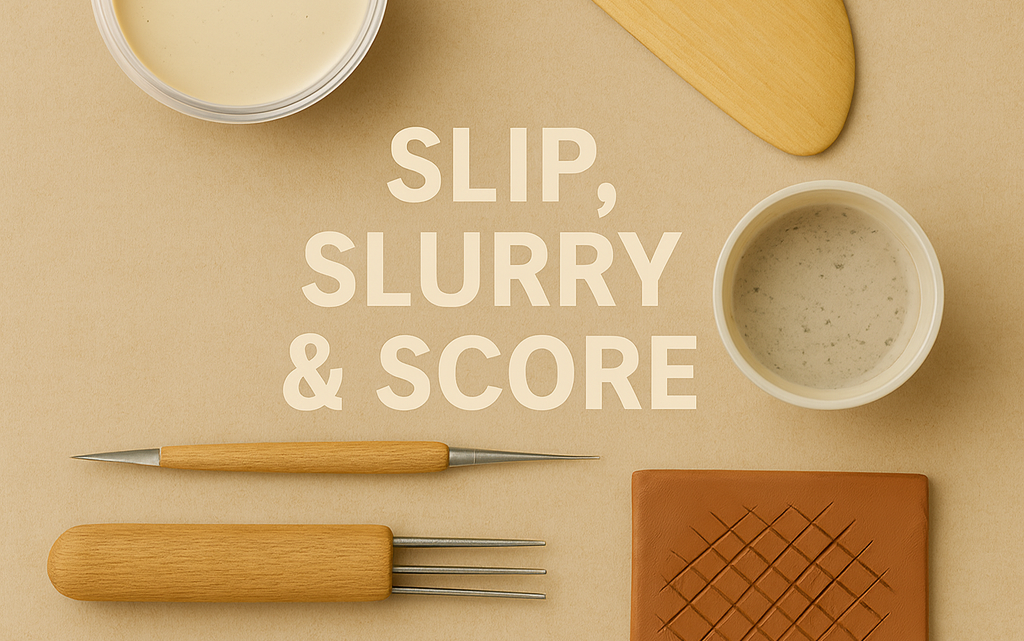
What Does Score and Slip Mean in Pottery?
If you’ve ever taken a pottery class or opened a clay kit, you’ve probably heard the phrase “score and slip.”
It might sound like pottery jargon—but it’s actually one of the most important techniques you’ll ever learn.
Without it, your clay pieces can crack, separate, or fall apart completely.
With it? You create strong, lasting connections that survive drying, firing, and everyday use.
In this guide, we’ll break down:
– What “score” means
– What “slip” and “slurry” are
– How to use them step-by-step
– And how to avoid the most common mistakes beginners make
Let’s dive in.
Why Potters Use the Score and Slip Technique
- Creates Strong Joins: Scoring creates grooves that allow the slip to fill in and lock pieces in place, which is much stronger than simply pressing wet clay together.
- Prevents Cracks: It prevents attachments, such as handles or decorative elements, from breaking off during the drying phase or after being fired in a kiln. Because clay shrinks as it dries, simply pressing two pieces together can result in weak joints that crack. The score and slip method ensures a uniform connection that survives the drying process.
- Essential For Hand-Building Clay: Score, slip and attach method ensures the structural integrity of hand-built pottery
What Is Slip?
Slip is simply clay + water, blended into a smooth, creamy consistency.
Think of it like pottery glue — because that’s truly what it is.
Slip can be:
- Thick like pudding
- Creamy like paint
- Thin like heavy cream
The thicker the slip, the stronger the bond.
Potters keep slip in everything from yogurt cups to mason jars to fancy slip containers — it’s a studio essential.
What Is Slurry?
Slip and slurry are often used interchangeably, but there is a difference:
Slip
Prepared, smooth, intentional, and often stored for later use.
Slurry
The watery clay that forms naturally in your bucket, on your wheel tray, or after sponging your hands — thinner, more inconsistent, and often filled with tiny clay bits.
Both can work in a pinch, but slip gives you a stronger join.
What Does It Mean to Score Clay?
Scoring means scratching the surface of the clay where you want to join two pieces.
Think of it like roughing up a surface before gluing it.
You can use:
- A needle tool
- A fork
- A serrated rib
- A scoring tool
- Even a stiff toothbrush in a pinch
You’re creating tiny grooves for the slip to fill — and once the clay is fired, those grooves lock together like Velcro.
How to Score and Slip Clay (Step-by-Step)
If you’re new to pottery, here’s exactly how to join two pieces of clay so they stay together:
1. Score both surfaces
Use a needle tool, fork, or serrated rib to scratch lines into both pieces where they will connect.
2. Apply slip
Brush or dab slip onto the scored areas. Make sure it gets into the grooves.
3. Press firmly together
Push the pieces together so the slip and grooves interlock.
4. Blend and smooth the seam
Use your finger, a rib, or a wooden tool to smooth the joint and remove any visible seam.
5. Reinforce if needed
For handles or heavier joins, add a small coil of clay and blend it in for extra strength.This method creates both a mechanical bond (from scoring) and a chemical bond (from slip)—which is why it works so well.
Read our full guide on how to score and slip clay.
So Why Do We “Slip and Score”?
Because clay shrinks as it dries — and smooth surfaces don’t bond well.
Slip and score creates a mechanical lock and a chemical bond.
Without it?
- Handles fall off
- Attachments crack
- Coils separate
- Projects break during drying
- Glaze firing becomes a heartbreak waiting to happen
Slip + score = structure, strength, and happy potters.
Common Myths About Slip & Score
“You don’t need to slip and score if the clay is fresh.”
Not true. Even fresh clay needs a mechanical bond.
“Water works just as well as slip.”
Water alone is too weak — it creates slickness, not structure.
“My piece looks stuck together; it must be fine.”
Looks can be deceiving! Weak joins often don’t fail until after the bisque firing.
Common Mistakes When Scoring and Slipping Clay
Even experienced potters run into issues if they skip steps. Here are the most common mistakes:-
Not scoring deeply enough
Light scratches won’t create a strong bond.-
Using too much water instead of slip
Water weakens the joint instead of strengthening it.-
Joining clay at the wrong moisture level
Pieces should be similar in moisture (both leather hard or both soft).-
Not compressing the seam
Simply sticking pieces together isn’t enough—you need to blend the seam.-
Skipping reinforcement on heavy pieces
Handles and attachments often need extra support.Avoiding these mistakes can make the difference between a piece that lasts… and one that cracks in the kiln.
Your Clay Project’s Best Friend
Slip and score may seem like a small step, but it’s one of the most important skills in handbuilding. It ensures your projects stay together from the moment you build them until the moment you bring them home from the studio.
Once you’ve mastered it, you’ve unlocked one of the true fundamentals of ceramics — and every mug, sculpture, and bowl you build will thank you.
If you’re looking for Where to Buy Pottery Clay in Arizona, you can browse our available clay bodies here.
Tools You Can Use for Scoring Clay
You don’t need anything fancy to get started, but the right tools can make the process easier.
Common options include:
– Needle tools
– Serrated ribs
– Loop tools
– Scoring tools
– Even a fork or toothbrush in a pinch
As you continue working with clay, having dedicated tools can help you work faster and more consistently.
Frequently Asked Questions
What does score and slip mean in pottery?
It’s a technique used to join two pieces of clay by scratching the surfaces (scoring) and applying liquid clay (slip) before pressing them together.
Do you always need to score and slip clay?
For most attachments—especially handles, coils, or decorative elements—yes. It helps prevent cracking and separation.
Can you use water instead of slip?
Water alone is not as effective. It can actually weaken the bond instead of strengthening it.
What happens if you don’t score clay?
The pieces may stick temporarily but often crack or fall apart during drying or firing.
What is the difference between slip and slurry?
Slip is a prepared, smooth clay mixture. Slurry is usually thinner and forms naturally during working or cleanup.