
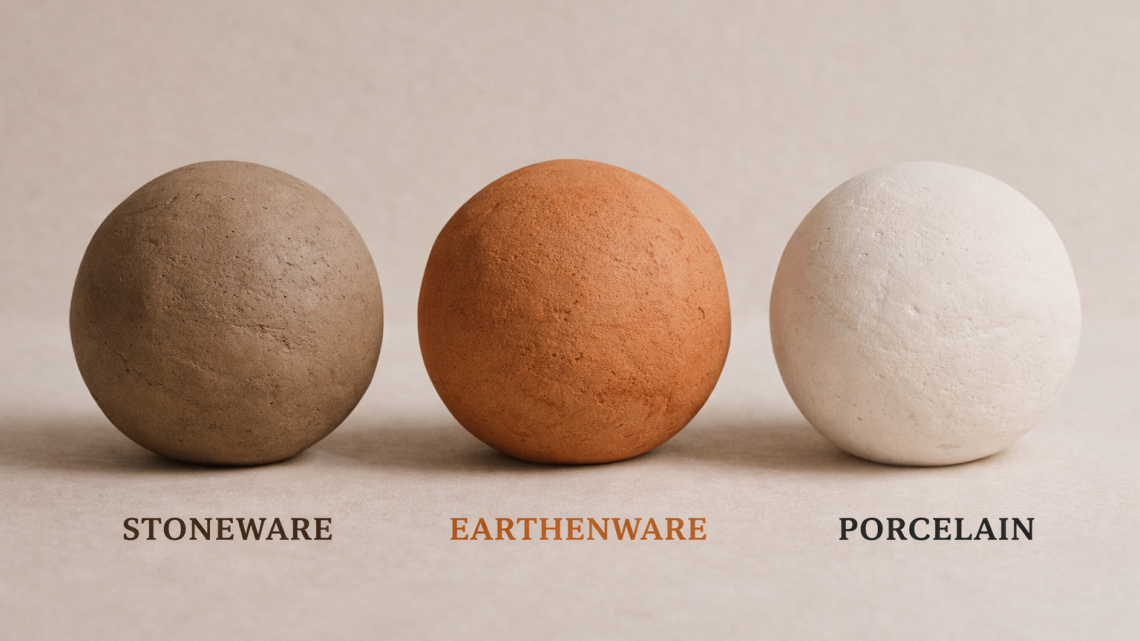
Stoneware vs. Earthenware vs. Porcelain: What’s the Difference?
If you’re new to pottery — or even if you’ve been working with clay for years — one of the most common questions we hear is:
“What’s the difference between stoneware, earthenware, and porcelain?”
All three are ceramic clays, but they behave very differently on the wheel, during firing, and in everyday use. Choosing the right clay can make your pottery journey smoother, more enjoyable, and more successful.
Let’s break it down in simple terms.
Stoneware Clay
Durable, versatile, and the most popular choice
Stoneware is the most commonly used clay in studios, schools, and production pottery — and for good reason.
Key characteristics:
- Fires at mid-range temperatures (typically cone 5–6)
- Strong and durable when fired
- Slightly coarse texture, but still smooth and forgiving
- Excellent for both wheel throwing and handbuilding
Why potters love stoneware:
- Forgiving for beginners
- Holds up well for functional pieces like mugs, bowls, and plates
- Works beautifully with a wide range of glazes
Stoneware is an excellent “all-around” clay and is often the first clay we recommend to new potters.
Earthenware Clay
Low-fire, colorful, and decorative
Earthenware is one of the oldest types of clay used in ceramics. It fires at lower temperatures and has a more porous finished surface.
Key characteristics:
- Fires at low temperatures (cone 06–04)
- Softer and more porous after firing
- Often red, terracotta, or buff in color
- Generally requires glaze for food safety
Best uses:
- Decorative pieces
- Sculptural work
- Planters, tiles, and craft ceramics
Because it fires at lower temperatures, earthenware is often used in classroom settings and for colorful, low-fire glaze projects.
Porcelain Clay
Smooth, refined, and challenging (but beautiful)
Porcelain is known for its silky texture and elegant appearance — but it’s also the most demanding clay to work with.
Key characteristics:
- Fires at high temperatures (often cone 10 or mid-range porcelain bodies)
- Extremely smooth and fine-grained
- Can be translucent when thin
- Less forgiving than other clays
Why potters choose porcelain:
- Clean, white finished surface
- Ideal for delicate forms and fine detail
- Stunning with celadons and translucent glazes
Porcelain is typically recommended for intermediate to advanced potters due to its tendency to slump, crack, or warp if not handled carefully.
Which Clay Should You Choose?
Here’s a quick guide:
- Beginners: Stoneware
- Functional pottery: Stoneware or Porcelain
- Decorative or classroom projects: Earthenware
- Fine, delicate work: Porcelain
- Studio or school programs: Stoneware (most versatile)
If you’re unsure, stoneware is almost always a safe and satisfying place to start.
Clay at Throw & Fire
At Throw & Fire, we focus on high-quality clay bodies that work beautifully for both beginners and experienced potters. We proudly carry stoneware clays that are ideal for wheel throwing, handbuilding, classrooms, and production studios.
If you ever have questions about which clay is right for your project or firing setup, we’re happy to help.
Ready to Get Started?
Browse our clay selection or stop by to talk shop — we love clay questions almost as much as we love clay itself.